
#601Record keeping and profitability analysis
601⸱AConcept
- Enhances financial transparency
- Improves profitability analysis
- Strengthens compliance capacity
- Facilitates informed decision-making
- Supports long-term farm resilience
Record keeping and profitability analysis are core elements of professional farm management. By systematically recording expenses, labor, and income, farmers gain understanding of their real cost of production and net profitability per kilogram or per hectare. This clarity allows farmers to decide which inputs to reduce and when is the best time to buy or sell.
When integrated with a harvest calendar, records also help families plan for larger expenses and loan repayments. Beyond farm economics, organized and traceable records strengthen transparency and accountability toward buyers, cooperatives, and certification schemes.
Overall, this tool supports informed decision-making and transforms farming into a more organized and sustainable businessthat is better prepared for market and climate-related risks.
601⸱BVideos
601⸱CTo be considered
All costs need to be captured, including visible expenses and less obvious ones such as family labor, transport, and services.
Income records should clearly indicate dates, volumes, prices, buyers, and any premiums received.
Consistency and traceability are essential: Use of standard measurement units and clearly link records to specific activities, such as harvests, or sales, makes data comparable over time.
Receipts, invoices, and input or labor logs should be organized and stored in a way that allows verification when needed.
Simple, frequent entries reduce errors, prevent information loss, and make summaries easier to compile. In addition, noting exceptional events, such as pest outbreaks, extreme weather, or market disruptions, helps explain changes in costs or yields.
Choose a simple system that fits your reality. It can be a notebook, standardized log sheets, or digital tools – there are different ways record keeping can be done, as long as it works for you. If you like, you can use the “HRNS Farmer Field Book - Record keeping and profitability analysis” that is provided in the Further Reading section below.
Above all, records should inform action. Data collection has value only when it is used to identify inefficiencies and adjust practices, improving profitability and resilience to market and climate risks.
Timing
Record keeping and profitability analysis should be applied continuously throughout the production cycle.
Regular entries, made daily or weekly, ensure that expenses, labor, and income are captured accurately and reduce the risk of missing information.
Monthly summaries help monitor cash flow and household or farm budgets, while seasonal or end-of-cycle reviews allow to calculate key indicators such as production cost per unit, selling price, and profit margins. These summaries provide the basis for evaluating performance and planning the next production cycle.
The time required is limited but depends on consistency. When records are updated regularly, daily or weekly entries take only a short amount of time, and reviews can be completed efficiently. Also, it ensures information is available when needed.
601⸱DImplementation
Materials
601⸱1Procedure
Set up the record-keeping system
A simple system that is easy to maintain is more effective than a complex one that is not used consistently.
601⸱2
Record farm activities and expenses
Labor often represents a major share of production costs and should always be recorded separately and clearly.
Unpaid labor should be valued using the standard wage rate for equivalent paid work. In practice, this means assigning the same cost that would apply if the activity were performed by hired labor.
601⸱3
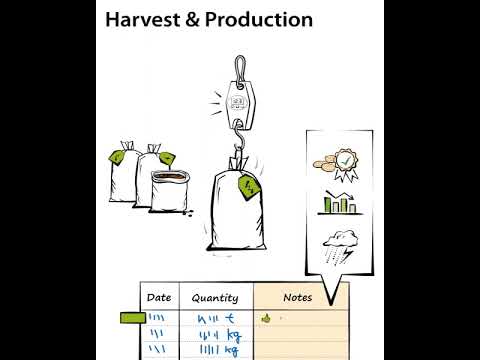
Record harvests and production
601⸱4
Record sales and income
601⸱5
Organize supporting documents
Ensure documents can be linked to the corresponding records when needed.
601⸱6
Review and analyze records
Using consistent units over time allows meaningful comparison across seasons and supports reporting to cooperatives, buyers, or certification schemes.
601⸱7
Maintain and update the system
601⸱EEconomic benefits
Better Cost Control
This tool helps identify and reduce unnecessary expenses.
Improved Profitability
This tool helps understand which practices and inputs give the best return.
Informed Decision-Making
This tool helps make data-driven choices for investments, input use, and labor.
Enhanced Planning
This tool helps forecast income and budget for the next season with more accuracy.
Market Negotiation Power
This tool helps know your real production costs to negotiate fair prices.
601⸱FGreen benefits
Efficient resource use
This tool helps reduce excessive use and environmental impact of inputs like fertilizers, water, and energy by tracking them.
Improved Soil and Land Management
This tool provides a better understanding of costs and yields, encouraging sustainable practices like mulching, cover crops, or crop rotation.
Adaptation to Climate Variability
This tool provides profitability insights, allowing farmers to invest in climate resilience practices in response to weather changes or extreme events.
Reduced carbon footprint
This tool enhances the efficient use of inputs and transportation that lowers emissions per unit of coffee produced.
Support for Sustainable Investments
This tool provides profitability insights, allowing farmers to invest in sustainable practices and technologies (shade trees, drip irrigation, erosion control).
Long-Term Farm Viability
This tool helps maintain both economic and ecological balance, supporting an ecological system over the long term and increasing resilience to climate shocks and market fluctuations.